

Order TempGuard
Packaging
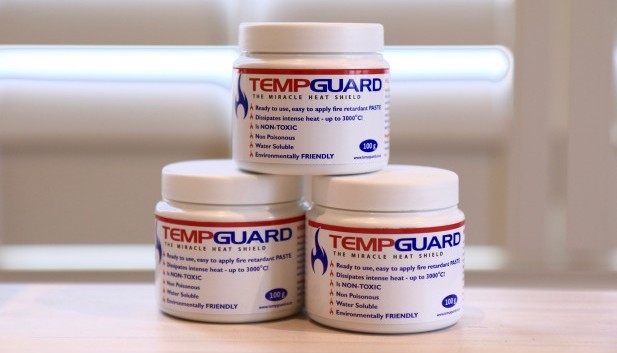
TEMPGUARD IS AVAILABLE IN SEVERAL SIZES.
For individual use:
- 1 kg tubs with tamper-proof lids
For industrial use:
- 5 kg buckets
- 10 kg buckets
- 25 kg buckets
Larger container sizes can be arranged as required by the customer.
Delivery Terms
YOU HAVE 3 DELIVERY OPTIONS:
- FREE delivery in Johannesburg, RSA.
- Collection at our offices (by prior arrangement only).
- Courier service – local and international.
Please note: A 3rd party vendor will be contracted to perform your courier service.
In order to get an estimated courier fee, please fill in our order form.
Frequently Asked Questions (FAQ)
How much TempGuard should I use?
The amount of TempGuard required to provide adequate protection depends on the specific application. Usually, a coating of TempGuard paste 10-20 mm thick, is sufficient in most applications for short time periods.
We strongly suggest you test a small area first, in order to determine the thickness required.
How should TempGuard be stored?
Keeping TempGuard sealed in its container when not in use is very important. Do not let the paste dry out, as this will decrease the effectiveness of the product. Store at room temperature.
What package sizes are available?
Please refer to our packaging section above. Contact us should you have a specific requirement, and we will try our best to assist.
What are the uses for TempGuard?
Below are some of the current uses for TempGuard paste, however its applications are potentially LIMITLESS when it comes to heat protection…
Engineering
Protection of metallic and other surfaces during the process of heating, welding, cutting etc. Acts as an effective barrier against welding splatter.
Flame retardant for insulation of wires and electrical cables. It is used as a cable lubricant and protection for cables installed in conduits over long distances, for example, electrical cables and television cables. Here it is used as a lubricant when slipping the cable within the conduits. After the slip process the ends of the cables need to be sealed to ensure air tightness.
Very high temperature lubrication of metallic parts or components. Acts as a high duty lubrication of hot, highly stressed bearing surfaces like those encountered within artillery mechanisms.
Used in oil well drilling mud for the protection and cooling off of drill bits.
Jewellery industry
To prevent heat damage to precious stones, or during soldering, to protect a previous join from heat. VIDEO HERE
Industrial
An enhancement to existing protective and industrial clothing for operating personnel, where the risk of exposure to a high temperature environment is considered particularly high – for example: firemen, rescue workers and electricity supply workers, welders, arc furnace workers and engineers.
It can be used in just about any industry that exposes its personnel to direct heat sources and for protecting people and objects from heat damage, simply apply directly on skin.
In conjunction with specially designed protective gloves when handling hot or very hot materials for the protection of hands, arms, and upper body when working in a hot environment. Examples are the jewellery making, glass, ceramic, metallurgical, chemical, foundry and automotive [exhaust repair and body welding] industry
Emergency services
The protection of trapped accident victims when a cutting torch needs to be used.
As a heat barrier for stuntmen or fire-fighters, or rescue personnel.
DIY
Used to prevent heat damage to paintwork on wood, electrical insulation, plastic, glass.
Plumbing
Used to prevent heat damage to surrounding material when soldering pipes. Prevents damage from heat creep to leas free valves.
Construction
Inside panels of wooden doors or structures to delay and/or prevent fire damage or disintegration.
Used as a heat barrier in building and construction applications.
The provision of a heat barrier in the walls of safety boxes for high value items and documents [resistance to cutting torches].
Automotive/aviation
Can be used as a heat barrier between engine and passenger compartments in vehicles or airplanes.
Can be used to encapsulate a part that may be sensitive to heat (fuel lines, sensors, electronics etc) or form a protective barrier to a high heat part (e.g.exhaust, battery, mechanical parts).
Medical
In medical and dental laboratories where heat may affect biological material or molds.